Some Big Picture Resources
Some collective resources (& a free event!) to help make sense of AI in Higher Ed

This will be a shorter post than usual (maybe?). My goal with this post is to just highlight a couple rich resources that I’m maintaining, perusing regularly, or just think other people should know about.
Syllabi Policies for Generative AI - Repository
Most folks reading this are familiar with this one, but we’re approaching the fall semester so it’s an opportuntiy to contribute or review. I started building the Syllabi Policies for Generative AI - Repository in January 2023, and it is probably one of the things that I have become most known for. So many wonderful people have referenced it and a great many more have used. It contains over 210 policies from different syllabi from across the world. It has been created and contributed by amazing people, people I know, people I don’t know, and it continues to grow. You can add or update your policy in the collection.
If you’re ever looking for different examples of how you might describe or explain your policy in your course, if you want to see how other people in your discipline are thinking about or discussing AI, if you want to try to find language that captures yours or to borrow or adapt others, it’s a really great resource. You can explore by disciplines, courses, level of rights. That is, some of them have Creative Commons licenses, others have public domain. For many, you canborrow and adapt and, of course, give credit.
AI Plagiarism Cases
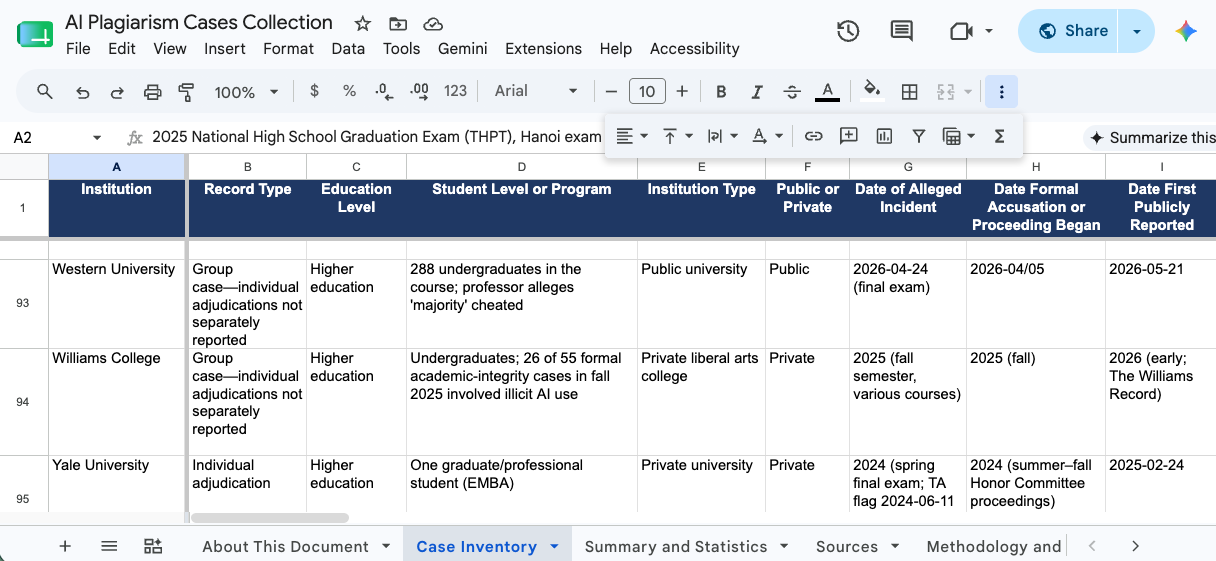
This is one of my newer experiments and explorations; it’s a collection of AI Plagiarism Cases Collection across education. I have been using deep research with Claude to build this out, and I’m using Claude’s schedule task to regularly update, and I’m curious to see how this goes in terms of its ability to do that consistently.
This is essentially is an ongoing database of incidents in higher education and K-12 of accusations of AI usage of students. It includes a little bit about which institutions are invovled, whether AI plagiarism detectors have been used, what level of deliberation (within the institution, legal fall out, etc), if the case has been resolved and how. There’s also a summary of statistics tab that’s interesting to peruse.
My interest in this, like any others, is to follow the discourse and get a sense of what is going on in terms of AI accusations and the results from them. I want to see where all this is going and to what degree these cases pan out (or don’t). I’m also concerned about the level of accusations occurring, particularly when AI plagiarism detectors are involved. This piece on a legal framework about AI misuse from Inside Higher Ed.
Higher Ed Accreditation - AI Tracker
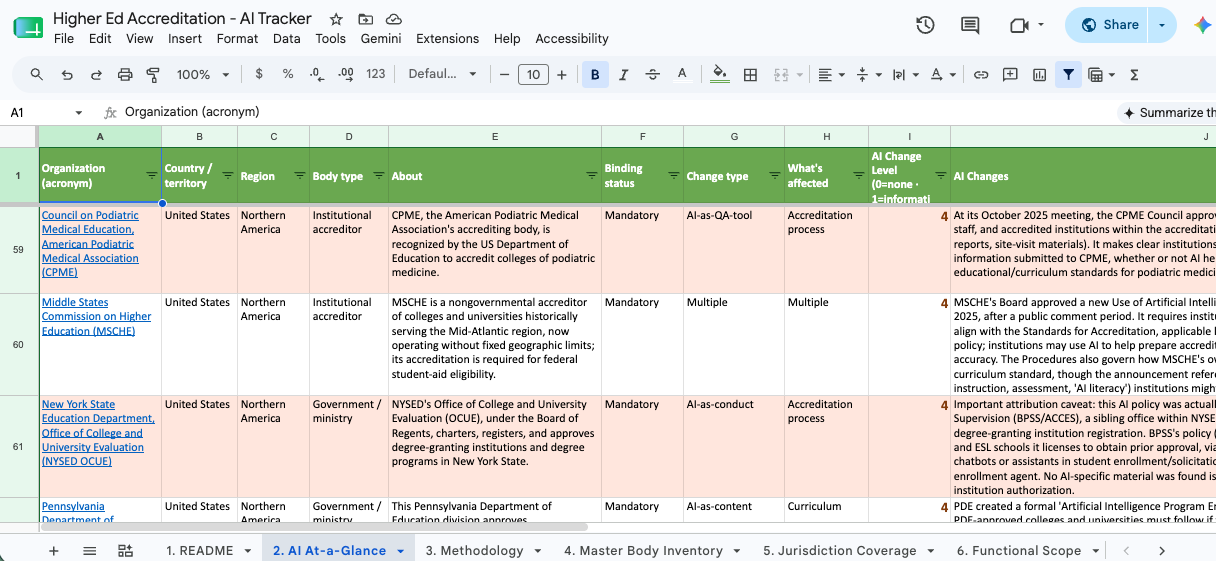
Similar to the AI Plagiarism Cases above, I’ve been using Claude CoWork and ChatGPT Codex to develop this Higher Ed Accreditation - AI Tracker. So what is it? First, it’s a fairly comprehensive list of accreditors/regulatory bodies related to higher ed with a particular focus on degrees, curriculum, accreditation. This includes those that accredit institutions as a whole but also individual programs and lots inbetween. It’s also global, so it’s not just the US, but hundreds of organizations and accrediting bodies. Each includes a brief description of what it does. That alone is a really interesting collection to explore!
But more important (for me and others in this space) is that it focuses on whether those bodies have made changes or introducing changes related to accreditation or regulatory expectations related to curriculum, programs, accreditation, etc with relation to artificial intelligence. It provides a score (0-5) of degree of change and a description of what those changes are as well as the current status of the change (implemented, proposed, etc).
Similarly to the AI Plagiarism Cases, I’m running Schedule Task with a Skill to repeat the research and review cycle to update this resource going forward.
Again both of these are experimental and so feedback, insights, etc are welcomed. To me, this might be one of those really helpful ways to leverage AI that helps us try to follow complex fields and spaces to get the gist, understand trends, and know where to look for more detail.
AI Faculty Cohort Programs Collection
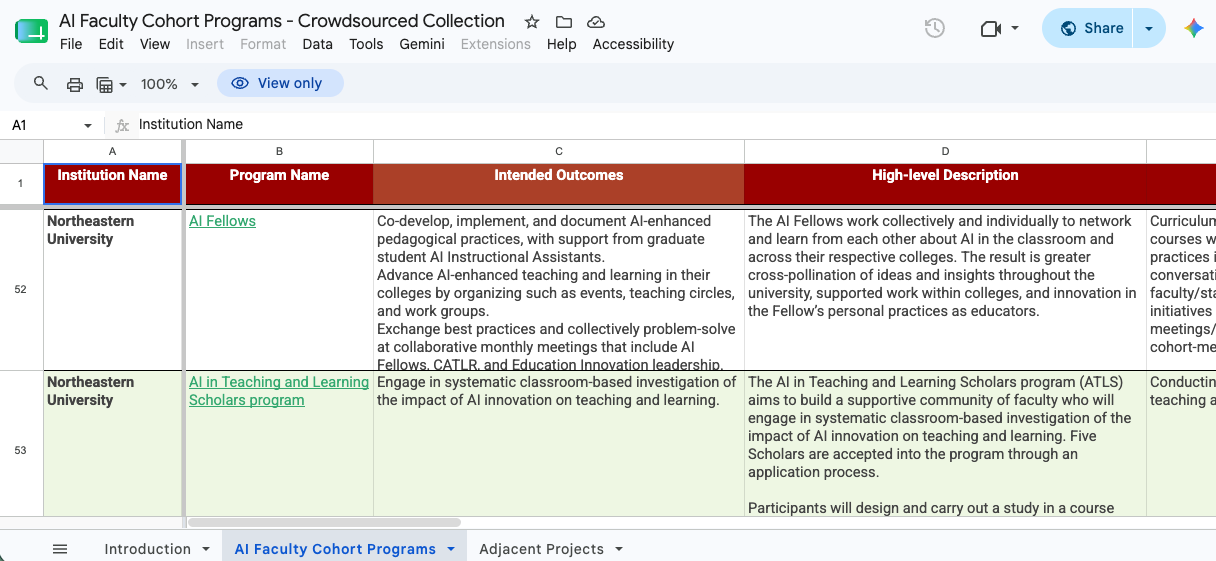
The Center for Advancing Teaching and Learning Through Research at Northeastern University (where I work during the day!) has been crowdsourcing a fantastic resource of AI Faculty Cohort Programs. This collection (now, over 130 programs from across the world) provides great insights about the different faculty-focused programs that are doing the work of sense-making and community to figure out AI at their institutions over the last few years If you’re running such a program and are not on the list, please consider adding yours here.
Additionally, they will be hosting a free virtual summit for facilitators and faculty of AI-focused faculty cohort programs on Tuesday, August 11 and Wednesday, August 12 from 10am-2pm (ET) each day. This summit is open to faculty and staff in higher education who are running or are interested in running cohort-based programs around AI for and with faculty. You can register here.
AI Policies, Guidelines, and Governance
I also want to highlight the great work that Joe Sabado has been doing. If you are looking for insights as to what institutions are doing, then check out his resource: AI Policies, Guidelines, and Governance. With hundreds of colleges and universities, this collection (which you can download as 1 large Word document) can really provide you with a sense of what institutions as a whole or comparitaitve instituions are doing. Really, the whole CampusExchange.AI site is worth exploring and bookmarking.
AI Ethics & Policy News
Dr. Casey Fiesler is a great and critical voice in understanding AI in this moment. Her collection of AI Ethics & Policy News spreadsheet is a phenomenal resource several thousand articles (well-categorized!) of research and publications regarding the complexities and concerns of AI. It’s great with one caveat in that it seems to have stopped being updated in January 2026.
Generative AI Product Tracker
The Generative AI Product Tracker from ITHAKA looks particularly at AI products marketed towards faculty and students and provides additional context and insights. It’s one of my first-go-to places when I encounter a new tool and want some clearer insight about it.
AI Use Cases in Higher Education: A Community Handbook
Dr. Aviva Legatt from Higher Ed AI Playbook has assembled this collection of AI Use Cases in Higher Education: A Community Handbook that captures a range of interesting use-cases, insights, data, and reports. I often find myself perusing and discovering something new every time.
The Update Space
Upcoming Sightings & Shenanigans
Keynote speaker at the Reimagining the Liberal Arts in the Age of AI Conference, July 21-23 at the University of Mary Washington.
Panelist on a general sessions panel (AI Leadership Choices: Building the Ecosystem from Foundation to Scale) at UPCEA’s SOLAR conference in Boston on July 30 at 2:30pm.
EDUCAUSE Online Program: Teaching with AI. Virtual. Facilitating sessions: ongoing
Recent Recordings, Resources, & Writings:
Davis, L., & Eaton, L. (May 2026). Expanding OER with GenAI. EDUCAUSE Review.
AI x Higher Ed Podcast with Anand Rao & Stefan Bauschard. Episode: Universities Must Adapt to AI—Here’s How They’re Doing It (May, 2026)
Damm, C., & Eaton, L. (2026, March). From prompt to practice: A framework for transparent GenAI use in higher education. EDUCAUSE Review.
Eaton, L., Nemeroff, A., & Sun, X. (2026). AI-assisted course design and development. In K. S. Ives, M. Cini, & R. Schroeder (Eds.), AI applications in online higher education administration: Strategies for maximizing returns and improving outcomes. Routledge.
Margin of Thought with Priten: Season 1, Episode 5: How Can We Center Pedagogy During the AI Tech Wave? (February 2026)
Online Learning in the Second Half with John Nash and Jason Johnston: EP 39 - The Higher Ed AI Solution: Good Pedagogy (January 2026)
The Peer Review Podcast with Sarah Bunin Benor and Mira Sucharov: Authentic Assessment: Co-Creating AI Policies with Students (December 2025)
David Bachman interviewed me on his Substack, Entropy Bonus (November 2025)
The AI Diatribe Podcast with Jason Low (November): Episode 17: Can Universities Keep Pace With AI?
The Opposite of Cheating Podcast with Dr. Tricia Bertram Gallant (October 2025): Season 2, Episode 31.
The Learning Stack Podcast with Thomas Thompson (August 2025). “(i)nnovations, AI, Pirates, and Access”.
Intentional Teaching Podcast with Derek Bruff (August 2025). Episode 73: Study Hall with Lance Eaton, Michelle D. Miller, and David Nelson.
Dissertation (2025): Elbow Patches To Eye Patches: A Phenomenographic Study Of Scholarly Practices, Research Literature Access, And Academic Piracy
AI Syllabi Policy Repository: 200+ policies (always looking for more- submit your AI syllabus policy here)
Finally, if you are doing interesting things with AI in your higher ed classrooms, consider being interviewed for this Substack or even contributing. Complete this form, and I’ll get back to you soon!
We periodically host small-group workshops and leadership sessions for higher ed teams. You can learn more about our current offerings here.
AI+Edu=Simplified by Lance Eaton is licensed under Attribution-ShareAlike 4.0 International