Sharing 2025's Talks & Workshops
A collection of materials and resources that I've been creating over the last year...

On a regular basis, I share my previous work; this is part of my open educational practices, where I make things I’ve created for other audiences available to anyone here who may want to use and adapt them (they all come with Creative Commons licenses). See previous examples on this substack, December 2024, June 2024, and December 2023.
2025 ended up being another big year where I was invited to do dozens of talks, keynotes, and workshops across the country (and even international invitations). Somewhere within this, I have passed the 100 mark (at least if we count panels and podcasts). Some I share shortly after the talk itself, but others don’t always make it. Sometimes, it’s because various parts of it have already been shared (some talks are naturally re-ordered/slightly adjusted for different audiences), and sometimes, it’s because I didn’t have the opportunity to spend time pulling together the materials into a coherent form.
But since I want to make sure to practice openness and make such things available to others, here are the resources and slide decks from the past year!
I’m splitting them this year into talks and workshops. It’s not a perfect split, in that I’m sometimes brought in to do a talk followed by a workshop, but it should be good enough for folks to find and explore what makes sense to them.
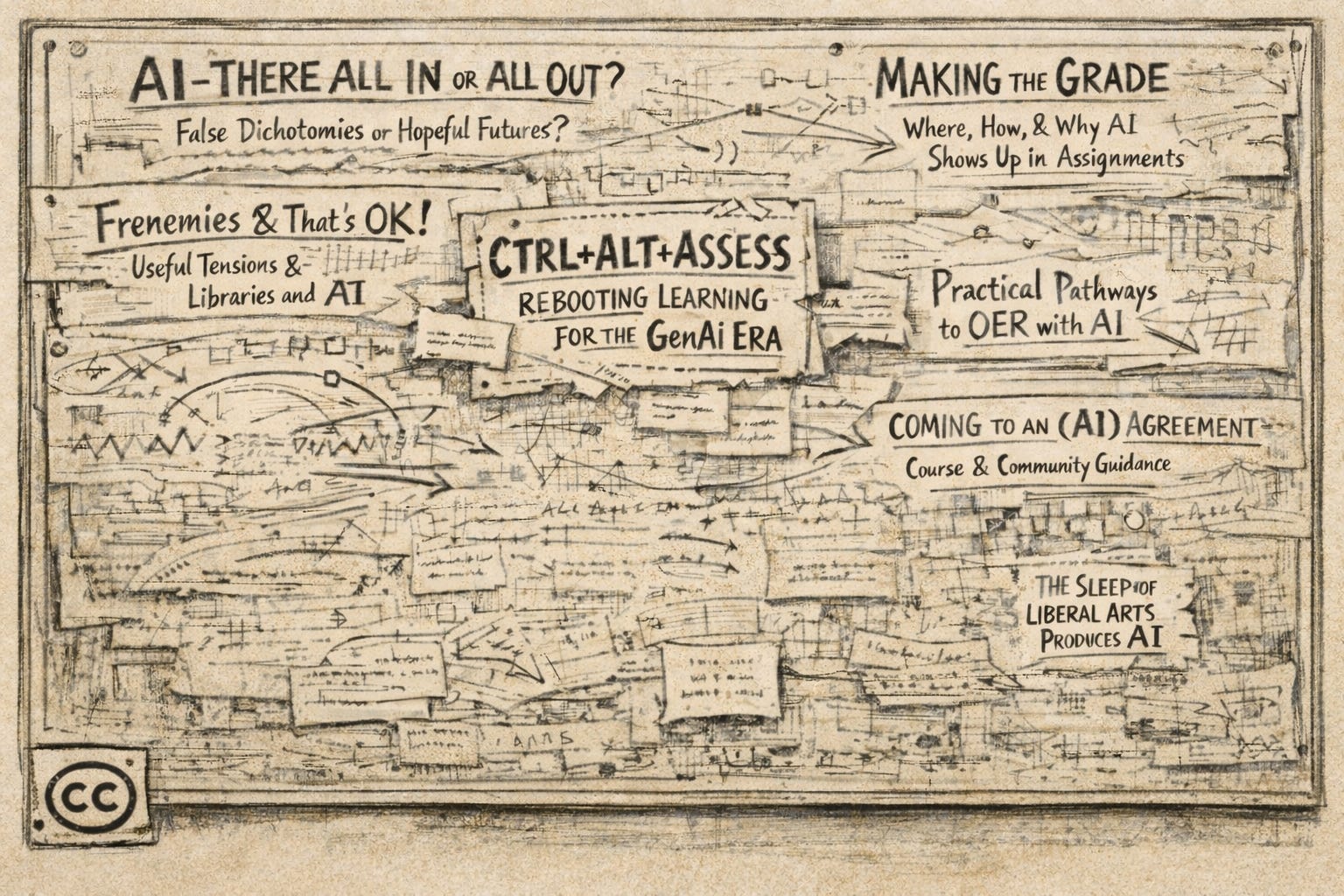
Talks
AI-There All In or All Out: False Dichotomies or Hopeful Futures?
This was a talk near the start of the year. It was building off my NothingBurger talk but also creating some space for more back and forth dialogue with the attendees.Frenemies & That’s OK: Useful Tensions & Possibilities Between Libraries and AI
This talk was for the URI Library Sciences program (and shared here as well). I mean, anytime I’m getting to hang out with librarians is always a good time!Ctrl+Alt+Assess: Rebooting Learning for the GenAI Era
This talk was one of the turning points for my talks in the second half of the year where more and more we moved from the basic intros about GenAI into thinking about how it shows up in learning and assessment. I also shared the text to this one in a previous post.Making the Grade: Determining Where, How, & Why AI Shows Up in Assignments
This one is a slightly abridged version of the one above but also some added details that I did late in the year for an international audience.Pratical Pathways to OER with AI
This year, I began doing a lot more around OER and AI. My colleague, Antonia Levy & I did a session on NERCOMP about AI, OER, & UDL (and forthcoming article!). But I also jumped into thinking about ways AI might mesh with OER. I ended up doing this talk (and workshop below) that helped me to build out this working framework of using AI with OER.The Sleep of Liberal Arts Produces AI
Finally, the talk that I felt strongest and proudest about was this one. It’s not perfect but I felt that it captured a lot of the tensions that I am trying to think through as it relates to AI and well, academia in general. By the way, if you haven’t read Rhoan Garnett, PhD’s remix of this talk, then you’re missing out on the beauty of Creative Commons and the remix possibilities.
Workshops
This year had me doing a lot more workshops with facutly and organizations. Some of these were 1 hour sessions and others were half-day or a series of sessions. What I’ve done here is share the main slide deck, the guidance and resource document (with instructions for activities on the tabs in the documents) and any other ancillary materials that I might have created. As always, they’re covered with a CC license and you’re welcome to adapt if you find them useful.
Engaging with Generative AI
This workshop was designed for helping faculty to start to play around with GenAI. It provides them with an assortment of prompts to try out and directions on how to go about using them with an GenAI tool of their choice. After they play a bit with provided prompts, they are then given a prompt to refine and adapt to their context. They test it out and share their findings. In the final activity, they use a prompt to be interviewed by GenAI to consider what that experience is like and how that could be useful in their teaching and learning.
4 Part AI Series for Faculty Getting Comfortable with AI
Session 2: Potentials & Pitfalls with Generative AI Part 1: Faculty Usage - Slides
Session 3: Potentials & Pitfalls with Generative AI Part 2: Student Usage - Slides
Like the workshop above, this is aimed at bring faculty from first encounters to a deeper understanding about GenAI and where it might (and might not) show up in their courses (and why). It provides opportunities to try out prompts, test out some tools, and reflect on their usage, their peers’ usage, and their students.
AI Workshop Series for Engineering Faculty
This four-part series focused specifically on Engineering faculty as a university brought me in to do a series to help the faculty to individually and collectively consider how they might start trying things out for themselves and with their students.
AI-Readiness in Higher Education
This workshop had particiapnts explore what it means to design assignments that would include AI in some capacity and what that might look like for their particular courses.
Orientating a ID Team for AI
I know—there’s a lot of resources for this one. This was the first of a series of workshops that I did in the last third of the year, where I would craft out about 3-4 hour-long activities and let the participants decide which one they wanted to go with. It sounds (and can be) a little chaotic, but it also reflects some of my own beliefs about teaching and navigating GenAI which is provide some choice and build some trust with the participants. In this case, the workshop focused on getting a large team of instructional designers and instructional technologists to collectively think about what it means for their team to use GenAI and how they might start to do so in a way that aligns with the team’s values and the institution’s goals.
Aligning Learning: Where AI Should & Shouldn’t Be in Your Department
Similar to the workshop focused on a team, this one focused on engaging with and supporting the faculty in a given department to collectively learning, explore, and reflect about what these tools mean for their discipline and how they move forward.
Coming to an (AI) Agreement: Creating Course and Community Guidance About AI Usage
I wrote about this workshop earlier but wanted to include it here. The workshop was part of the Public AI Summit and focused on how to help folks develop a sense of understanding about GenAI concerns and potentially build common ground for policies around it.
Practical Pathways to OER with AI
This workshop guided folks through the framework I highlighted above to get them to start thinking about where AI might fit in their OER journey. It was three activities that moved them from locating OER content with AI to testing out some OER-related prompts for AI to engaging with an OER Adoption bot.
Teaching in Stereo: How Open Education Gets Louder with AI
Similarly, but a bit more defined as it was later in the year, this workshop got folks interacting with AI to consider how and where it might fit into their OER workflow.
Again, this isn’t an exhaustive list but I think it’s the list that has the least amount of replication or too much overlap. If you find yourself using it in any way, I hope you’ll let me know as I always love to hear how these find their way out into the world!
The Update Space
Upcoming Sightings & Shenanigans
Continuous Improvement Summit, February 2026
EDUCAUSE Online Program: Teaching with AI. Virtual. Facilitating sessions: ongoing
Recently Recorded Panels, Talks, & Publications
The Peer Review Podcast with Sarah Bunin Benor and Mira Sucharov: Authentic Assessment: Co-Creating AI Policies with Students (December 2025)
David Bachman interviewed me on his Substack, Entropy Bonus (November 2025)
The AI Diatribe Podcast with Jason Low (November): Episode 17: Can Universities Keep Pace With AI?
The Opposite of Cheating Podcast with Dr. Tricia Bertram Gallant (October 2025): Season 2, Episode 31.
The Learning Stack Podcast with Thomas Thompson (August 2025). “(i)nnovations, AI, Pirates, and Access”.
Intentional Teaching Podcast with Derek Bruff (August 2025). Episode 73: Study Hall with Lance Eaton, Michelle D. Miller, and David Nelson.
Dissertation: Elbow Patches To Eye Patches: A Phenomenographic Study Of Scholarly Practices, Research Literature Access, And Academic Piracy
“In the Room Where It Happens: Generative AI Policy Creation in Higher Education,” co-authored with Esther Brandon, Dana Gavin and Allison Papini. EDUCAUSE Review (May 2025)
“Does AI have a copyright problem?” in LSE Impact Blog (May 2025).
“Growing Orchids Amid Dandelions” in Inside Higher Ed, co-authored with JT Torres & Deborah Kronenberg (April 2025).
AI Policy Resources
AI Syllabi Policy Repository: 190+ policies (always looking for more- submit your AI syllabus policy here)
AI Institutional Policy Repository: 17 policies (always looking for more- submit your AI syllabus policy here)
Finally, if you are doing interesting things with AI in the teaching and learning space, particularly for higher education, consider being interviewed for this Substack or even contributing. Complete this form, and I’ll get back to you soon!
AI+Edu=Simplified by Lance Eaton is licensed under Attribution-ShareAlike 4.0 International