The Reverse Centaur's Guide to Life After AI by Cory Doctorow
A review of Doctorow's latest work on AI

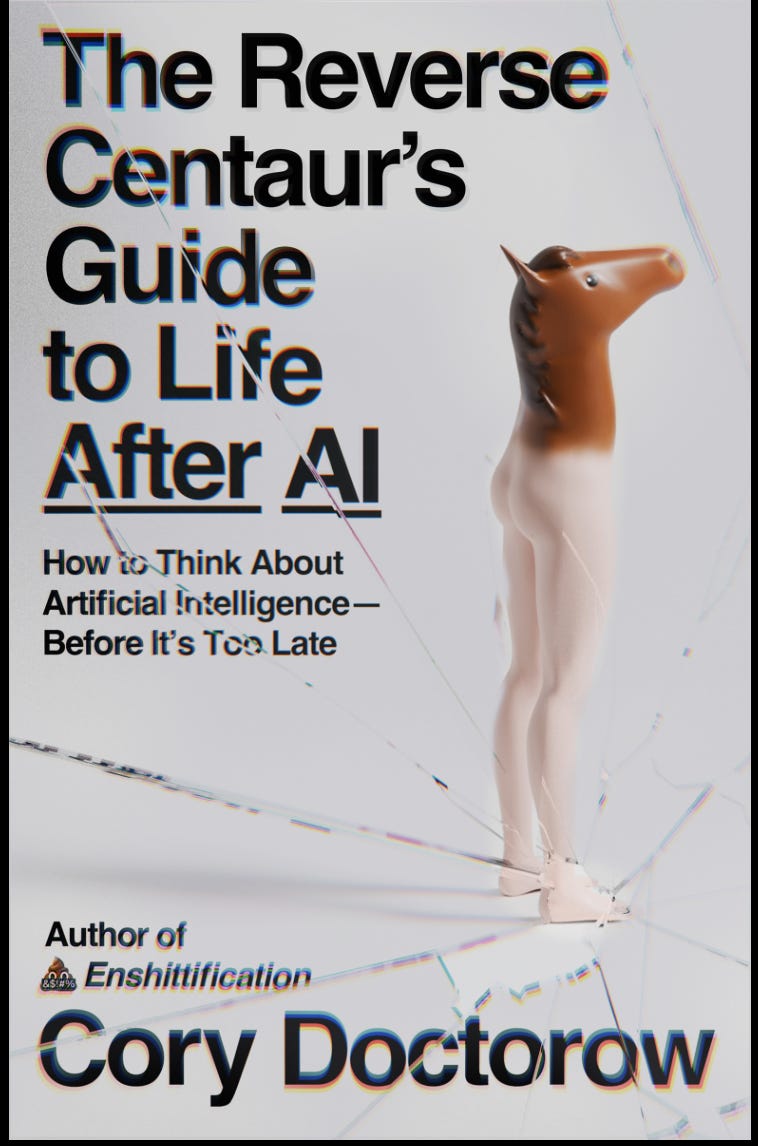
I don’t often do book reviews here—in fact, I’m not sure I ever have. I typically leave that over for my other blog (yes, I run 2 blogs; this one will soon be 3 years, and the other one is 16 years old). However, I happened to just finish Cory Doctorow’s The Reverse Centaur’s Guide to Life After AI and since it’s relevant to here, I figured it might be of interest to folks.
I supported Doctorow’s Kickstarter for the audiobook, because I believe deeply in Doctorow’s work and ethic around publishing but also I regularly his work because feels like an inoculation against the tech bro BS that surrounds so many conversations about technology. The book continues his work and connects directly to Enshittification, Chokepoint Capitalism, The Internet Con, and How to Destroy Surveillance Capitalism. In many ways, it feels like the AI-specific version of the same larger project: look past the gadget, look past the hype, and look at the larger techno-social capitalist system that decides who benefits and who gets used up.
That is Doctorow at his best. He does not treat AI as magic, or as an inevitable apocalypse, or as a neutral tool that just happens to exist outside power. He keeps asking the better question: who does this technology do things for, and who does it do things to? That centaur/reverse centaur distinction is the book’s frame. There is a real difference between a person choosing a tool that helps them do their work and a person being forced to become the human assistant to a machine that is ultimately being used to de-skill, discipline, or replace them.
That nuance is appreciated given that the AI discourse feels stuck between two unhelpful poles: AI is the future and we should all worship it, or any use of AI is automatically horrible, limiting, and meaningless. To my delight and appreciation, Doctorow is much more interesting than that. He is deeply skeptical of the AI bubble, of the promises by tech bro trillionaires, of the sales pitch that AI will become the next employer revolution. And he leaves space for smaller, useful tools: voice-to-text, transcription, image manipulation, local models, things that are as he tells us boring in the best way. I was using voice-to-text to gather my own thoughts for this review, so that point felt especially relevant. There is something here. It just is not necessarily the thing being sold to us.
In this book, he does go into copyright, which some of you may know, I have lots of thoughts about (from my dissertation, to this piece in the LSE Blog, to this previous post). Given how much of my own work has been in and around copyright, knowledge production, and AI, I found Doctorow’s argument both clarifying and affirming. He reinforces what I have thought for a while: AI itself does not challenge copyright in the way many people want it to. If we think it does, we may be misunderstanding copyright and misunderstanding who copyright usually serves. It generally does not serve creative artists. It often serves corporations.
Doctorow’s takedown of “copyright will save us from AI” is one of the strongest parts of the book because it moves the conversation away from a tempting yet inadequate answer and toward labor, bargaining power, ownership, and control. That is a harder conversation, and it is also the more honest one. A new copyright framework around AI training sounds appealing until you remember who usually owns, controls, and exploits copyright. If the solution is one more right that creators can be forced to sign away, then it may not be a solution at all. Ultimately, there’s not a clear pathway that will actually be successful to trying to end or dismiss AI on copyright claims. In many ways, that makes sense. It is not copying and as soon as you get into the claim that works “inspired’ by copyrighted artists, you largely collapse a whole bunch of possibilities about how we as humans learn (hint: we copy a lot until we can build from our insights).
Doctorow’s chapter on AI’s role in art does not just throw all of AI away. He is skeptical, rightly, of someone entering a prompt, accepting whatever the machine gives them, and putting it into the world without much thought or meaning-making. But he also recognizes that art has always been entangled with technology. To say this new technology can have no role in art feels too heavy-handed and historically shortsighted. We have had versions of this conversation before, and we are usually wrong when we insist that a new technology cannot possibly matter to art.
An interesting idea can be found and named in Doctorow’s work. The more we get sucked into the fetishizing, demonizing, or aggrandizing the narrative (even in from a critical lens), the more power we actually give over to it. It’s like it’s Pennywise, feeding and growing bigger on our fears. Every time we get sucked into that coversation, we’re feeding the beast. It’s not explicit but does emanate from the text.
Where the book gets harder for me is the “guide” part. Doctorow diagnoses the problem really well, yet he doesn’t really guide us through it beyond “thinking”. He points toward unions, worker control, co-ops, better social arrangements, and creative workers resisting becoming reverse centaurs. It does signal possibilities. He discusses the Writers Guild successful rejection of AI, but they are a class of workers with unusual leverage compared to the vast majority of people being pushed into reverse-centaur conditions. A lot of people do not have the agency, solidarity, money, time, or infrastructure to resist.
And even beyond the workplace, a lot of consumers will choose what is cheaper or faster because the system is designed that way. We see it in self-checkout. We see it in online ordering and delivery. We see it in the way convenience gets framed as individual choice. He doesn’t go so far to label those seeking convenience as villains, rather explains as how they may be creating pathways that lead to their own exploitation.
Knowing that these issues permeate AI as many of our other digital systems does not quite empower us.
I felt something similar with his discussion of agentic AI. Doctorow is right that agentic AI, especially as a commerce fantasy, is probably a dead end. The idea that we will all have bots comparison-shopping, negotiating, and improving outcomes for us runs straight into the reality that companies will use their own systems to counter ours, block transparency, and prevent real enrichment. In a country with no meaningful federal data protection laws around consumer data, that seems incredibly likely.
Still, I am not entirely convinced that means agentic AI has no value. When I use these tools, I am often approaching them less through the lens of capital and commerce and more through tinkering, exploring, and trying to do things I could not easily do before. That may not be the domain of this book, and maybe it is not Doctorow’s purpose here, but it just feels like a limitation. The critique of the investment pitch is strong while the sense of what individuals might do with these tools outside that pitch feels thinner. Of course, that does make sense of the book and its focus; it’s just his handling of agentic AI doesn’t have the same nuance that generative AI does (which makes me wonder if he has actually played with it).
Doctorow makes a persuasive case that the AI bubble is built on several houses of cards: financially, technically, and rhetorically. He is also right to push back against the glamorous superintelligence conversation when the real harms are predictive policing, wage theft, surveillance pricing, deepfakes, misinformation, and the redistribution of money and power upward. The obsession with whether AI is sentient or whether it will overpower us is such a distraction. The small, nimble, insidious uses are the ones most likely to creep in while everyone is looking elsewhere.
I finished the book asking, okay, what am I to do with this? If I am in a workplace where AI is being forced down my throat and I do not have meaningful ways to resist, what are my realistic options? How do we address these systems in ways that are thoughtful and not exhausting? Doctorow warns about the damage that could happen before the bubble bursts, and about the economic disaster that may follow, but the book does not really guide us through that. It gives me a better map of the trap without a better toolkit for living inside it.
That is not entirely fair to put on this book, and I know it is not fully Doctorow’s project. I deeply appreciate his analysis, his open access commitments, his Creative Commons practice, and the consistency of his work. I keep listening to his books and funding his audiobook Kickstarters because his voice is invaluable. After Enshittification, The Internet Con, and now this, there is also a slightly repetitive quality. Repetitive, informative that is not always breaking new ground. Some examples and arguments recur because they are central to his framework, but in this book, that repetition sometimes makes the limits of the “how” more visible.
Regardless, The Reverse Centaur’s Guide to Life After AI is valuable. For Doctorow fans, it is another strong dose of clarity. For people who have not thought much about AI, it may be genuinely useful. And for people who are hypercritical of AI, it gives permission to have a more nuanced view: reject the bubble, reject the exploitation, reject the bosses trying to turn workers into reverse centaurs, but do not pretend every tool is meaningless just because the industry around it is rotten.
Doctorow is at his best when he is slicing through the capitalist approach to technology while still recognizing the individual or collective value (but not “Value”) of these tools. That is the strength of this book, even when it falls short as a guide. It helps clarify what AI is, what it is not, what is being sold to us, and who is likely to pay the cost. I just wish it left me with a clearer sense of what comes next.
The Update Space
Upcoming Sightings & Shenanigans
Co-facilitator with Dr. Rhoan Garnett of this Myfest session: Structuring AI in Our Learning: What Are We Missing in the Conversation? on Wed, July 1 at 12pm (ET).
Keynote speaker at the Reimagining the Liberal Arts in the Age of AI Conference, July 21-23 at the University of Mary Washington.
EDUCAUSE Online Program: Teaching with AI. Virtual. Facilitating sessions: ongoing
Recent Recordings, Resources, & Writings:
Davis, L., & Eaton, L. (May 2026). Expanding OER with GenAI. EDUCAUSE Review.
AI x Higher Ed Podcast with Anand Rao & Stefan Bauschard. Episode: Universities Must Adapt to AI—Here’s How They’re Doing It (May, 2026)
Damm, C., & Eaton, L. (2026, March). From prompt to practice: A framework for transparent GenAI use in higher education. EDUCAUSE Review.
Eaton, L., Nemeroff, A., & Sun, X. (2026). AI-assisted course design and development. In K. S. Ives, M. Cini, & R. Schroeder (Eds.), AI applications in online higher education administration: Strategies for maximizing returns and improving outcomes. Routledge.
Margin of Thought with Priten: Season 1, Episode 5: How Can We Center Pedagogy During the AI Tech Wave? (February 2026)
Online Learning in the Second Half with John Nash and Jason Johnston: EP 39 - The Higher Ed AI Solution: Good Pedagogy (January 2026)
The Peer Review Podcast with Sarah Bunin Benor and Mira Sucharov: Authentic Assessment: Co-Creating AI Policies with Students (December 2025)
David Bachman interviewed me on his Substack, Entropy Bonus (November 2025)
The AI Diatribe Podcast with Jason Low (November): Episode 17: Can Universities Keep Pace With AI?
The Opposite of Cheating Podcast with Dr. Tricia Bertram Gallant (October 2025): Season 2, Episode 31.
The Learning Stack Podcast with Thomas Thompson (August 2025). “(i)nnovations, AI, Pirates, and Access”.
Intentional Teaching Podcast with Derek Bruff (August 2025). Episode 73: Study Hall with Lance Eaton, Michelle D. Miller, and David Nelson.
Dissertation: Elbow Patches To Eye Patches: A Phenomenographic Study Of Scholarly Practices, Research Literature Access, And Academic Piracy
AI Syllabi Policy Repository: 200+ policies (always looking for more- submit your AI syllabus policy here)
Finally, if you are doing interesting things with AI in your higher ed classrooms, consider being interviewed for this Substack or even contributing. Complete this form, and I’ll get back to you soon!
We periodically host small-group workshops and leadership sessions for higher ed teams. You can learn more about our current offerings here.
AI+Edu=Simplified by Lance Eaton is licensed under Attribution-ShareAlike 4.0 International