
"Sometimes, a measure of subversion is exactly what’s needed in a system that is not ethical."
Part 1 of an interview with Priten Soundar-Shah


About the Interview series
As part of my work in this space, I seek to highlight the folks I’ve been in conversation with or learning from over the last few years as we navigate teaching and learning in the age of AI.
If you have experiences around AI and education in higher education classrooms that you would like to share, consider being interviewed for this Substack.
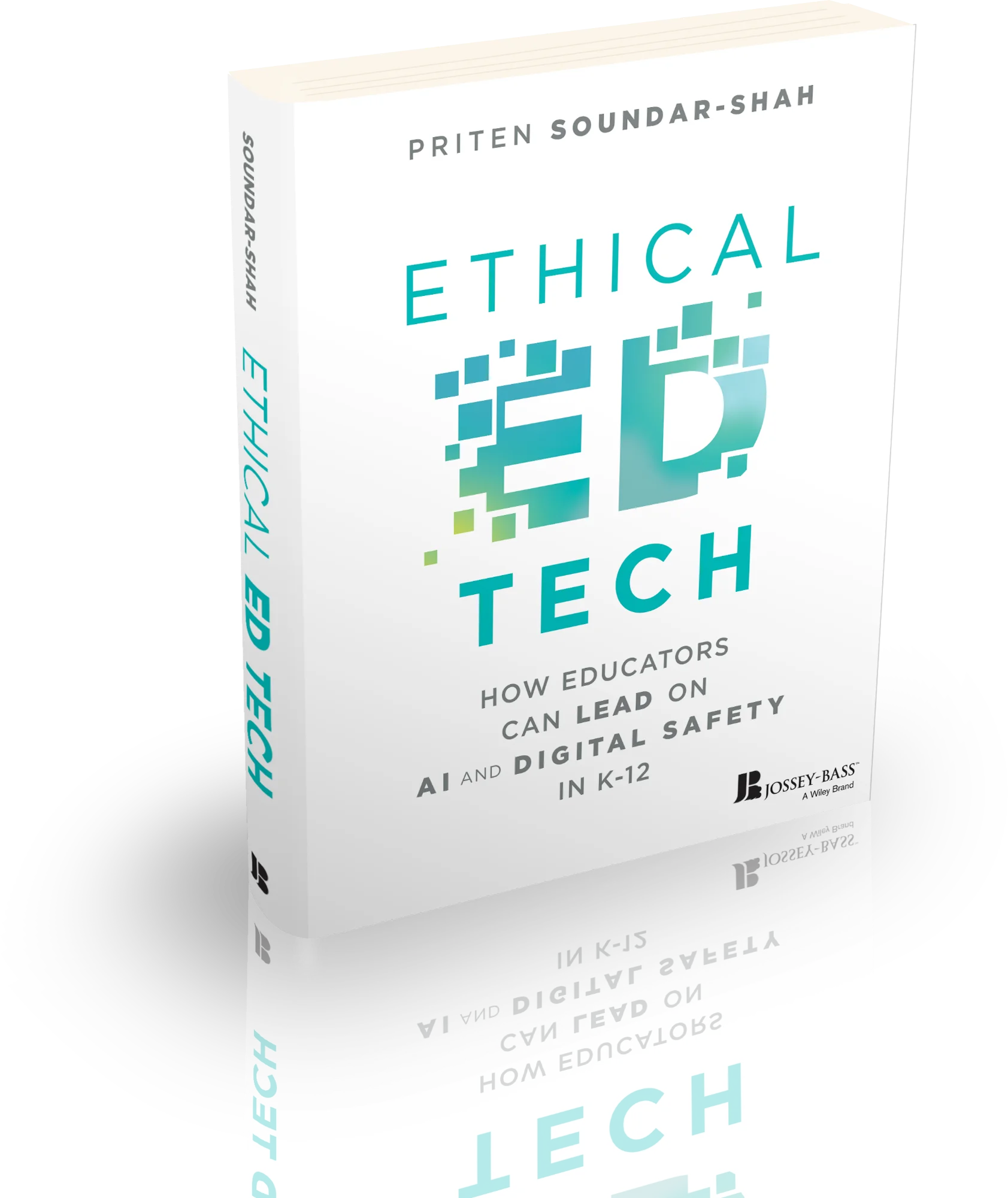
Priten Soundar-Shah is an educator, philosopher, and entrepreneur working at the intersection of technology and education. He leads three nonprofits, serving as Executive Director of PedagogyFutures, President of Academy 4 Social Civics, and CTO of Thinker—organizations collectively focused on ethical ed tech, civics education, and scaling critical thinking instruction worldwide. Priten is also the author of AI & The Future of Education: Teaching in the Age of Artificial Intelligence (Wiley, 2023) and the recently published book Ethical Ed Tech: How Educators Can Lead on AI & Digital Safety in K-12 (Wiley, 2026).
Lance: Your first book (AI & The Future of Education: Teaching in the Age of Artificial Intelligence) helped educators understand what AI is and how it might be used. This book (Ethical Ed Tech: How Educators Can Lead on AI & Digital Safety in K-12) is leaning into that harder question of how we adopt this and how we decide. What led you to this book from that book? Why don’t you share about that?
Priten Soundar-Shah: My own intellectual journey through these ideas is important. When the technology first came out, my developer brain was fully on. When the November 2022 ChatGPT launch happened, and the technology became widely popularized, I was excited. I thought, there are all these cool things I’m already building, and now they can be twenty times more powerful. Here’s a way for me to make things more effective and productive.
Then some reality set in once I started talking with clients and educators. The amount of fear I heard within a month or two, let alone in the first six months, made me realize I was only thinking with my tech hat on.
At that point, my mission felt like bridging those gaps. I could talk about the tech, I could build with the tech, I could see the possibilities, but I could also talk about pedagogy and the philosophy of education. My initial approach was: yes, there are things to be afraid of and things we should be cautious about, but there are also powerful things we could do that we’ve been trying to do for decades, if not centuries.
That narrative became heavily co-opted by the tech industry itself. That was the turning point for me. Instead of everybody resisting change, everybody was embracing it on terms set by the tech companies. I thought, okay, wait, this is the other side of the extreme. It’s not just about building tech literacy. We also have to be productive and intentional about how we make decisions about the technology. That was the initial impetus for the book.
Lance: You wanted to redirect the conversation?
Priten: I talk about how it was fear-based, and I still think that’s accurate. It was grounded in fear about how much agency and power we were losing as a community of educators. It felt like a tidal wave. It did not feel like we were in charge of the conversation anymore.
My question became: why are we not in charge? And it’s not unique to tech. We don’t have the bedrock needed to navigate any sort of crisis like this in a productive way as a community. The fact that it’s complicated technology only makes it more complex.
The hope with the book was to bridge that gap. Yes, we can dream about all the possibilities, but at the end of the day, we need to pick the right ones for our schools and communities, and we need to convince other people that those are the right ones. That’s where the book starts.
Lance: It focuses on K–12, but hearing what you’re discussing, I’m thinking about higher ed’s response. Some might say it’s been appropriate, and others might say it’s been everything all at once. What has been your take on higher ed engaging in the conversation and trying to figure this out for that space versus K–12?
Priten: I don’t think there are too many fundamental differences in terms of the actual conversations taking place in K–12 versus higher ed. There are a couple of big-picture philosophical differences that change how we approach those questions, but the questions themselves are relatively the same.
Two things make higher ed a lot harder. The first is that there’s a lot more autonomy on the part of the student. There’s a justification process of convincing the student that they ought to be in higher ed. Obviously, at the end of the day, you still need student buy-in for K-12, but it is substantially less optional. And I think there’s also a developmental difference, so the amount of paternalism we might want to exercise with a kindergartener is very different from what we would feel comfortable exercising with a first-year college student. That makes it complicated.
The second part is that education serves multiple purposes at once in both K–12 and higher ed, but I think the economic purpose of a college degree is just substantially more pronounced than that of K–12 education. While you can sit down with a middle school and really try to figure out what is best for students in terms of personal development, flourishing, and civic development, it’s much harder to place those at the forefront of decision-making in higher ed, because for a lot of folks the primary purpose of a college degree is to get a job. That changes the kinds of conversations we can have at the higher ed level in terms of how we think about those preliminary philosophical questions. In my view, that makes higher ed the harder of the two.
Lance: What do you see as some of the conversations in that space, then?
Priten: When we think about what we want for a graduating student, that’s where we need to start in both spaces. What is fundamentally the purpose of them going through our classrooms and through our school buildings? In higher ed, we often pretend there’s a broader mission in place. Most university websites—and maybe some alumni-facing or college recruitment data will talk about job placement—but rarely do you see a college mission statement that’s about job placement, right? Most mission statements are about intellectual development, transformative experiences, the liberal arts, and becoming a good member of society. Those things have become very disconnected.
Part of this for me is: can we figure out a way to take those things seriously: those fundamental values that we have as a community of educators at that level? And then can we work backwards to what the market is asking for, what students are asking for, and the problems our schools are facing in general? Because right now, we work the other way. We start with: recent graduates have told us that they need to learn how to prompt in order to be competitive in their first-year jobs, so let’s go teach everybody how to prompt.
There is a very myopic nature to that conversation, versus asking: what do we actually fundamentally want for our students that’s going to be true today, tomorrow, and ten years from now? And then how do we use our current context to get there? That’s the starting question.
How do we figure out how to have these conversations with all of these different stakeholders in higher ed? Predominantly, the student stakeholders are the hardest ones: how do we address their concerns, but also not lose sight of our values? That’s a challenge.
Lance: How much of the discourse and conversation around AI is less about AI itself and more about how it amplifies all these other issues we’ve already been navigating?
Priten: This was a challenge I wrote about in the book, actually. A good chunk of the book doesn’t even talk about the technology. The most important chapters of the book do not talk about technology, especially the first few. That’s because these are long-standing problems that we have not really figured out how to solve. We’ve band-aided them for the most part. To some degree, there were already crises happening in both K–12 and higher ed.
In K–12, there’s chronic absenteeism and engagement issues, and post-COVID, we saw a lot of those problems get worse. In higher ed, the student loan crisis in particular has created a very bad incentive cycle, where the focus on the economic value of a degree has gone up astronomically compared to the founding years of the country. It is a very different conversation now about what a college degree does, and the student loan crisis has a lot to do with that, reasonably so.
We have these really big problems with pretending that we’re providing students with one thing, but never circling back and asking, “Okay, is that really what we still want to provide?” That might be a real question. I hope we say yes, but there is also the possibility that we say no—that our higher education system is only going to be career preparation, that this is its fundamental purpose, and that we should rework college, whether bachelor’s or associate’s degrees, around placing you in your first job.
I do think most folks would feel that was a loss, and I hope that’s true. This is where the tech is a problem-maker, for sure. We really didn’t sit down and figure out how to structure our systems well enough so that any problem like this could be withstood.
Lance: This question of preparedness versus the bigger, deeper skills: we know it’s perennial, as you said. You can go back to the founding of our country and we’ve been having that conversation. Do you see anything genuinely grounded (versus, say, tech-bro hype) that suggests AI is forcing the question, particularly now, and that it’s important to get it right because (again, I know it’s tech-bro hype) of the idea that there are going to be fewer jobs in the future? What do you think?
Priten: I almost wish we would just operate with that assumption. We would get much farther if we didn’t play this game of trying to predict what the job market is supposedly going to be when our current students graduate. There is a lot of ambiguity around that question. I do not think anybody actually knows what jobs will look like in four years. Anyone telling you this is what we must teach every student in K–12, let alone higher ed, is kidding themselves about how much we can predict the nature of the job market and society in four years.
Honestly, if we operated under the assumption that the tech bros are right in this case, we would get much more quickly to the right questions we ought to be asking. But at the same time, even if they’re not 100% right, and jobs are not fundamentally different or only somewhat different, we still need to come back to what skills have been relevant for thousands of years, and what skills would become irrelevant very quickly if AI continues to progress. That would help us think more clearly about how to structure higher education.
There are things we’ve been teaching since the dawn of democratic society—since the beginnings of Western thought—and those things have been as relevant with the simplest technologies as they are today. That should tell us something. Everybody talks about the rate of change, but if you zoom out to the full extent of education in human society, this is not the biggest change. Think about shifts since Socrates—the cliché examples like the printing press or the computer. We’ve had other major technological transformations, and a lot of our fundamental curriculum has remained relevant through all of them.
That should tell us something about the purpose of education in a social sense. But yes, if we assumed the tech bros were right and then redesigned higher ed from there, we might get to a better place more quickly.
Lance: One of the points I’ve tried to make at times is that even if AI doesn’t get any better than what it is right now—and honestly, we can say, meh, there’s some really interesting stuff and plenty that feels like blah—even if it doesn’t improve, it’s forcing us to figure out better assessments. And we’re going to be better at responding to that, to your point.
In your book, you have this framework of philosophy, policy, and practice. I’m curious how that might work in an institution because, as you said, you have various levels of autonomy—from the classroom to the department to a college within a university, depending on how centralized or decentralized it is. How much do you begin at the top? How much do you begin at the ground level? How might you see that working out at a university, and how might that contrast with a different university context?
Priten: This is the unfortunate part about making ethical decisions in the real world: context matters so much, and you have to deal with real roadblocks. In an ideal world, the division of duties when it comes to dealing with AI and technology in general would be top-down when it comes to baseline protections. Can the university figure out the minimal safeguards we want to ensure for both faculty and students? How do we implement those?
And then we would leave pedagogical decision-making to individual classrooms. Unfortunately, neither of those is often the case. We’re not getting top-down protective measures, and we are getting top-down pedagogical mandates.
Those are the trickier cases to figure out because the responsibilities get flipped. Educators feel responsible for determining appropriate use in a harm-reduction model—which I wish were more top-down—and then they also have to deal with mandates such as, “We’ve now purchased XYZ tool, it’s in all of our LMS systems, and please try to use it because we’re paying a lot of money for it.”
That creates a dynamic where power is flip-flopped and responsibility is flip-flopped over who is making which decisions. In that case, a lot of this comes down to figuring out what your axes of control are as an individual educator.
This was also a major decision for the book: do I write for the education leader—whether that’s a school principal, superintendent, university president, or dean—or do I write for the folks directly in the classroom?
I chose to write for the people directly in the classroom. Part of that was optimism and hope that we will continue shifting these conversations to be more grounded in classrooms and provide more autonomy.
Lance: Why was it important to write to the folks in the classroom?
Priten: One natural consequence of the speed of AI, compared to technology developments over the last 15-20 years, is that a lot of this is happening at the classroom level. Universities have been slower to react in many cases, so a lot of decisions have been made individually by faculty and departments. That’s great in some ways. There’s more experimentation happening at that level, and there’s more innovation because of it.
At the end of the day, the classroom instructor is the last moment of control educators have in the interaction with the student. An example I’ve talked about recently is that top-down mandates are often obvious to students if the educator isn’t fully bought in.
I remember being a young student and being very aware of when my teacher was doing something because the principal said so, rather than when my teacher wanted to do it. It was blatantly obvious.
That remains true. Teachers are exercising judgment about what is appropriate, what they think is right for their students, what they think is right for their classroom, their teaching style, and their discipline. Those are all ethical decisions.
Regardless of what top-down mandates say, educators often find ways around them. I think that can be good. Sometimes, a measure of subversion is exactly what’s needed in a system that is not ethical. Those small acts can be important moments within a system.
Lance: I appreciate where the conversation is going because that dynamic of classroom agency is important. I’ve been thinking about it over the last two years politically because of everything going on, and thinking about this book Fugitive Pedagogy by Jarvis R. Givens. It’s felt especially potent the last 2 years las we saw how quickly the federal government moved to strike anything that had to do with DEI. Givens’s book looks at Cater Woodson and the Black educators who had to both teach a white curriculum and also teach Black students a curriculum of survival and the ways they had to sneak that in, the moments of resistance.
That’s a big preamble to say: as we’re talking about this, do you see in K–12 or college some of the resistance and concern from faculty and educators as being about what happens when we give over so much? The Alpha School conversation comes to mind as a case study within all of this.
Priten: This is why my narrative is so focused right now on slowing down. I know that is exactly the opposite of what many of the feelings in the space are, and the opposite of many of the pressures in the space. But those questions about the actual role of our institutions—if everything can be offloaded to AI—are really good questions to ask.
This is where techno-optimism matters: what the technology can do versus what it should do. That is the fundamental distinction I’m trying to draw. Let’s pretend the technology is fully capable of doing the XYZ things people say it can do. What does that mean for the role of an educator—not in an economic sense of what the labor market does with this, but in the sense of whether we would miss something by replacing educators with humanoid robots. What would the implications of that be?
Those thought experiments matter. If I had asked that question to classroom educators three years ago, I would have been laughed out of the professional development room. People would have said, “Just tell me whether the AI detector works or not.” They would not have wanted to sit with these broader thought experiments. But I’ve noticed a massive shift toward wanting to think about those kinds of things.
Some permanence is setting in now. The pacing is becoming clearer to people. It is much clearer that the band-aids are not working and will not work. So while we were seeking band-aids, we should also be asking what would happen if all our high schools were replaced with Alpha Schools. Is the backlash against that traditionalist resistance? Is it self-preservation by educators? Or is it that we’ve structured our systems to pretend something is important when something else is more important?
The focus on standardized testing, in particular, has set us up for these solutions to seem appealing. When we’ve spent the last twenty years heavily emphasizing test scores, Scantron-style assessments, and standardization in general, we’ve made teaching more robotic by incentivizing robotic outputs from students.
If the goal is to maximize literacy, reading, and math exam scores for fifth graders, then an AI tutor might help get you there. If you could solve for self-regulation and motivation and have a student interact with that AI tutor all day, maybe they would score higher on the end-of-year exams. Fine—we’ve achieved the standardized testing goal. But that focus has also meant we’ve missed other things. Character education has fallen out of the norm in many schools. Civics education is resurging in some places, but overall it remains marginal. We also have a larger loneliness crisis, and student mental health is declining.
That AI tutor is not solving any of that. None of those problems are addressed there. This is where calls for more research are good. We should test some of these things so we don’t miss potential benefits, and also so we don’t entrench potential harms. But we already have a great deal of educational research that we have not acted on. There is more than enough evidence for many changes.
For example, the research on the importance of having a teacher you can relate to is strong. That is why efforts to increase teachers of color and male teachers have evidence behind them. It matters when students have an educator they feel connected to, someone they trust and choose to build a relationship with.
That is not going to be solved by a robot. We already know that even placing a human educator from a different community in a classroom may not have the same effect as someone from the same community. If we know that, then we are kidding ourselves if we think a robot is going to do that job. We do not need an experiment to tell us that. We already have that information now.
Join us for the second part of the interview in a few days!
The Update Space
Upcoming Sightings & Shenanigans
Keynote speaker at the Reimagining the Liberal Arts in the Age of AI Conference, July 21-23 at the University of Mary Washington.
EDUCAUSE Online Program: Teaching with AI. Virtual. Facilitating sessions: ongoing
Recent Recordings, Resources, & Writings:
Davis, L., & Eaton, L. (May 2026). Expanding OER with GenAI. EDUCAUSE Review.
AI x Higher Ed Podcast with Anand Rao & Stefan Bauschard. Episode: Universities Must Adapt to AI—Here’s How They’re Doing It (May, 2026)
Damm, C., & Eaton, L. (2026, March). From prompt to practice: A framework for transparent GenAI use in higher education. EDUCAUSE Review.
Eaton, L., Nemeroff, A., & Sun, X. (2026). AI-assisted course design and development. In K. S. Ives, M. Cini, & R. Schroeder (Eds.), AI applications in online higher education administration: Strategies for maximizing returns and improving outcomes. Routledge.
Margin of Thought with Priten: Season 1, Episode 5: How Can We Center Pedagogy During the AI Tech Wave? (February 2026)
Online Learning in the Second Half with John Nash and Jason Johnston: EP 39 - The Higher Ed AI Solution: Good Pedagogy (January 2026)
The Peer Review Podcast with Sarah Bunin Benor and Mira Sucharov: Authentic Assessment: Co-Creating AI Policies with Students (December 2025)
David Bachman interviewed me on his Substack, Entropy Bonus (November 2025)
The AI Diatribe Podcast with Jason Low (November): Episode 17: Can Universities Keep Pace With AI?
The Opposite of Cheating Podcast with Dr. Tricia Bertram Gallant (October 2025): Season 2, Episode 31.
The Learning Stack Podcast with Thomas Thompson (August 2025). “(i)nnovations, AI, Pirates, and Access”.
Intentional Teaching Podcast with Derek Bruff (August 2025). Episode 73: Study Hall with Lance Eaton, Michelle D. Miller, and David Nelson.
Dissertation: Elbow Patches To Eye Patches: A Phenomenographic Study Of Scholarly Practices, Research Literature Access, And Academic Piracy
AI Syllabi Policy Repository: 200+ policies (always looking for more- submit your AI syllabus policy here)
We periodically host small-group workshops and leadership sessions for higher ed teams. You can learn more about our current offerings here.
AI+Edu=Simplified by Lance Eaton is licensed under Attribution-ShareAlike 4.0 International

 | A guest post by
|